
Lipedema self-diagnosis
Wondering if you have lipedema?
If you're wondering whether you have lipedema, it's important to diagnose yourself quickly. This disease can affect people regardless of their body mass index (BMI), making it difficult to determine lipedema solely by the appearance of the lower and/or upper limbs, especially in cases of obesity.
Here are the signs that may indicate the presence of lipedema in your body:
An unharmonious body
Your upper and/or lower limbs look and feel different from the rest of your body.
Impossible weight loss
Despite your attempts to lose weight through diet and exercise, only certain parts of your body have responded. Your waistline has become slimmer, but you haven't seen any positive changes in your lower/upper limbs despite your efforts.
Sensitivity to touch and pressure
This sensitivity can vary from one person to another.
Vascular fragility
Spontaneous appearance of hematomas on affected areas. Hematomas are difficult to remove and may leave marks.
Widening of the lower limbs
For the upper limbs, tissue enlargement stops at the wrists, while the hands retain a normal appearance.
You feel: Sensation of swelling and heaviness in the affected areas
In some advanced cases of lipedema: loss of mobility and muscle weakness, which can lead to mobility difficulties and abnormal gait.
Self-diagnosis of lipedema is the first step towards recovery.
Clinical signs of lipedema
A. Clinical signs of lipedema: how to diagnose them
Lipedema can be diagnosed by a variety of healthcare professionals, including angiologists, general practitioners and plastic surgeons. They will base their diagnosis on a set of clinical signs specific to lipedema, obtained through questioning and physical examination. During the consultation, the doctor will ask you questions about your history and symptoms of lipedema.
B. Clinical signs of lipedema: clinical examination.
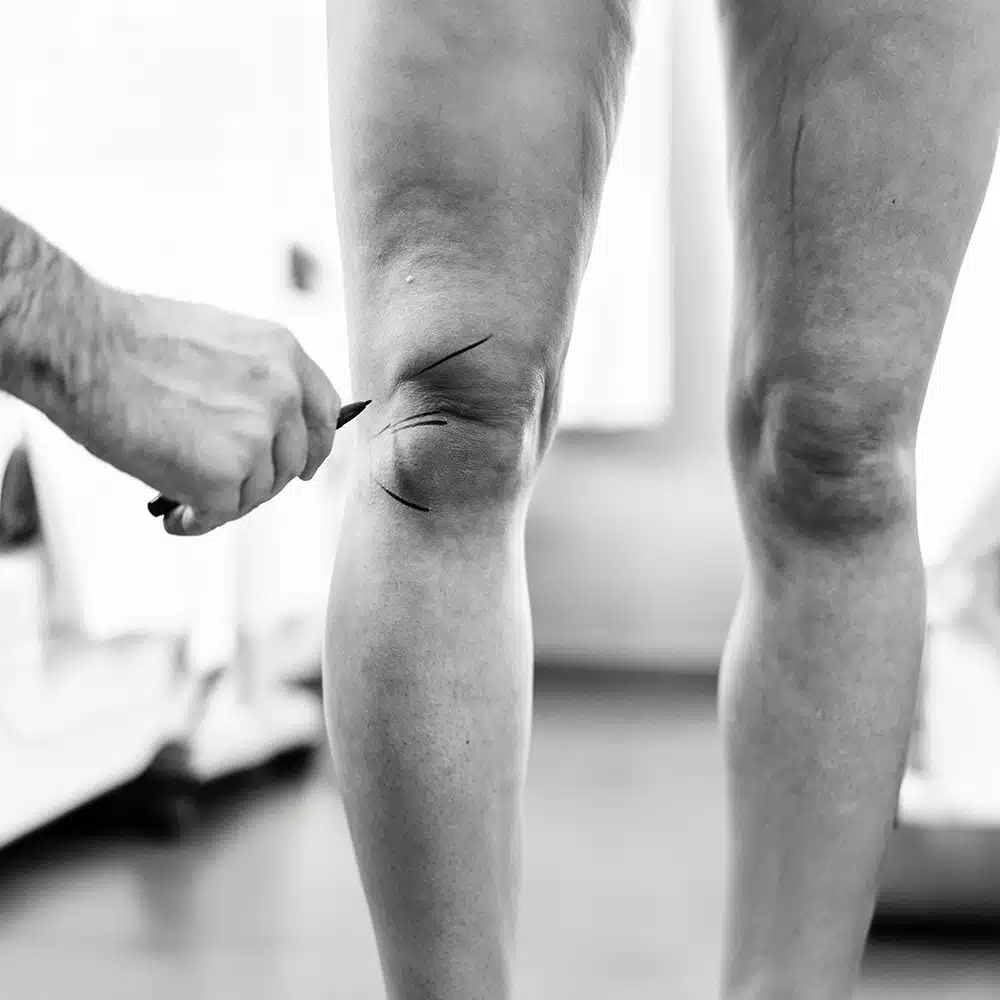
During the physical examination, the doctor will first observe the visual appearance of your body. In people with lipedema, there is a disproportion between the upper and lower limbs and the rest of the body, especially the waist, which remains thin in relation to the limbs. Joints such as knees and ankles may disappear in the lower limbs, while elbows and wrists may be faint and filled with fat in the upper limbs. Feet and hands, however, are unaffected and retain a normal appearance.
C. Clinical signs of lipedema: the "pole leg" appearance. On a global view of the body, the lower limbs have the appearance of "poles"."
When viewed as a whole body, the lower limbs may look like "poles". A characteristic sign of lipedema is the symmetrical, bilateral involvement observed on the patient's body. The professional will also examine the vascular system, and may visually note the appearance of varicosities, signs of vascular fragility, and perform an echo-doppler of the affected areas to get an overview of possible vascular damage.
Classification of lipedema
Lipedema does not manifest itself in the same way in all sufferers. It can be classified into different stages (evolution) and types (localization).
A. The 4 main stages of lipedema
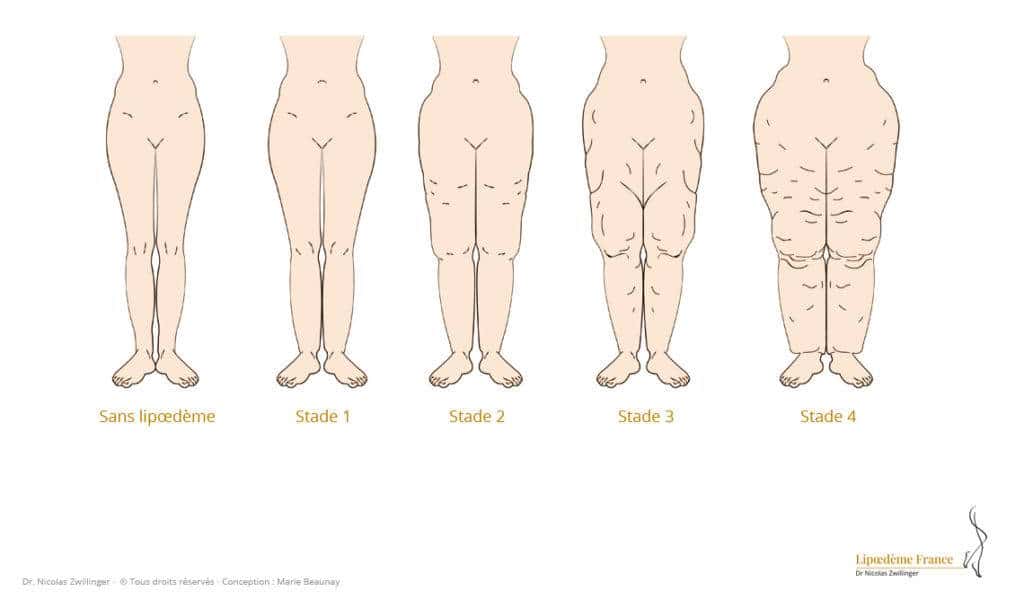
Lipedema can develop in four different phases. If left untreated, lipedema tends to progressively worsen. Here are the four main stages of lipedema:
The 4 main stages of lipedema severity :
The 4 main stages of lipedema in detail :
Stage I: Smooth skin surface, supple on palpation, uniform thickening of the hypodermis.
Stage II: Irregular skin surface, orange peel appearance, sensation of nodules on palpation.
Stage III: Hard skin surface, increased volume, deformed limb appearance, functional discomfort.
Stage IV: Lipo-lymphoedema.
It's important not to confuse lipedema with lymphedema, which is an accumulation of lymph rather than fat. There are several signs that help to differentiate these two conditions:

| Lipoedema | Lymphedema | Obesity | Venous insufficiency | |
| Gender | Women | Women + men | Women + men | Women + men |
| Big legs | Bilateral + symmetrical due to adipocyte hypertrophy | Unilateral due to excess fibrolymphatic tissue | Symmetrical (adipocyte hypertrophy) | Unilateral or bilateral (related to venous edema, not adipocyte hypertrophy) |
| Hypersensitivity | Significant sensitivity to palpation | No | No | Cramps + pins and needles |
| Pain | Absent, moderate or intense pain | Continuous pain or burning sensations in the limb | Osteoarticular pain | Pain at the end of the day + standing |
| Oedema | Yes (soft texture with no cup sign) | Yes (bucket sign) | Possible | Yes in late stages (bucket sign) |
| BMI | Normal or close to 25 | Normal | > 32 | Normal |
| Spontaneous blues | Yes | No | No | No, but varicose veins/varicosities/telangiectasias at different stages |
| Affects hands and feet | No | Yes | Yes | No |
| Stemmer's sign(inability to pinch the skin between the 2nd and 3rd metatarsals) | No | Impossible | No | No |
| Lymph flow | Normal, defective or altered | Obstructed | Normal | Normal |
| Skin | Normal, cellulite or nodules | Rough texture, dry, sclerotic skin | Skin folds, stretch marks, cellulite | Ulcers, pigmentation, eczema |
B. The 5 types of lipedema
Types of lipedema are determined by the location of fatty deposits and edema. There are five main categories of lipedema:
- Lipedema type I: Hips/buttocks.
- Lipedema type II: From buttocks to knees (included).
- Lipedema type III: buttocks to ankles (included).
- Lipedema type IV: Arm.
- Lipedema type V: Calves only

Complementary lipedema assessment: a must before surgery
During the initial consultation with a plastic surgeon specializing in lipedema, a number of additional tests are requested prior to any intervention.
A. Complementary assessment of lipedema: venous Doppler ultrasound
A Doppler ultrasound of the deep and superficial venous network will be performed to observe radiological signs in the patient. This study will help assess venous circulation in the limbs, which is essential prior to cosmetic surgery using W.A.L. liposuction. It will also help determine whether varicose vein surgery is required prior to W.A.L. liposuction.
B. Complementary assessment of lipedema: lymphoscintigraphy for advanced stages
In advanced cases, notably stages 2, 3 and 4 according to the medical classification of lipedema, Dr. Nicolas Zwillinger may request a lymphoscintigraphy performed in nuclear medicine centers. This examination provides a precise analysis of the patient's lymphatic state, and helps determine the lymphatic component that may be associated with the disease, explaining the enlarged limbs.
C. Complementary lipedema assessment: a blood test is also necessary
Prior to W.A.L. liposuction, the plastic surgeon requires a pre-operative blood test to detect any anemia or iron deficiency. All these additional results enable Dr. Nicolas Zwillinger and his team to plan a precise therapeutic strategy to treat the patient safely and comprehensively.
We recommend consulting the page dedicated to lipedema treatment to find out more about the treatment options available.