
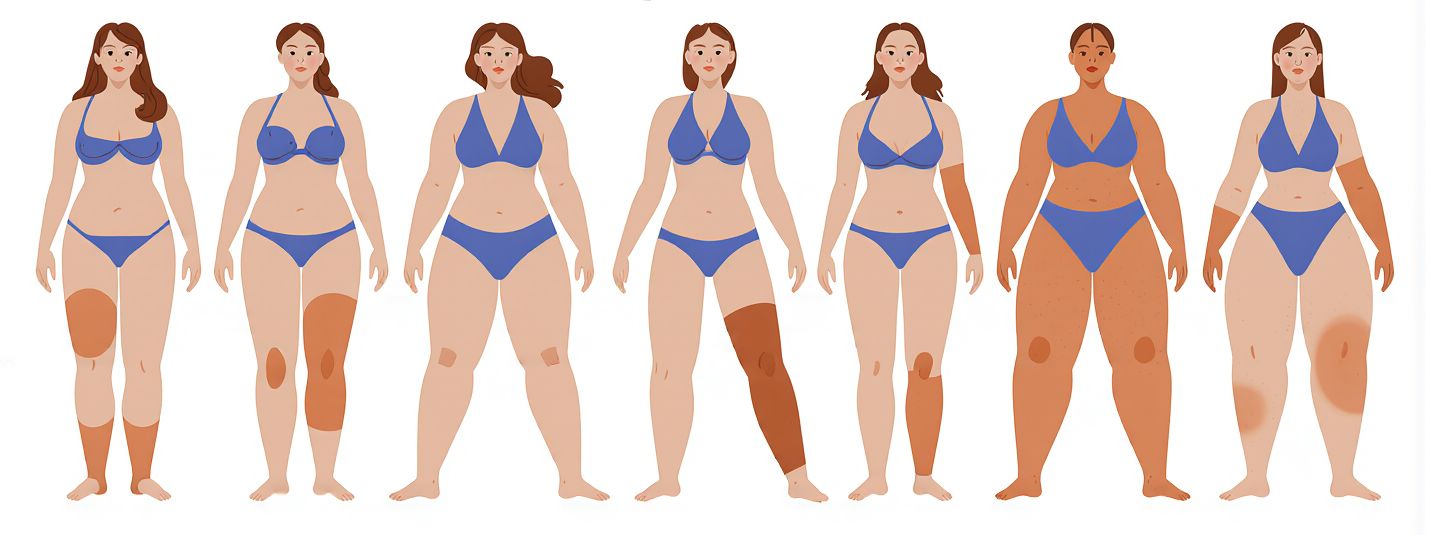
Lipedema: A Little-Known and Often Misdiagnosed Condition
People with lipedema face many challenges.
Many people are not recognized by healthcare professionals as having this condition or are misdiagnosed. Awareness of lipedema among healthcare providers is low, and little clinical research focuses on this condition.
To date, no quality guidelines for the management of the condition have been published, resulting in inconsistent and often inappropriate care for people with lipedema.
Multidisciplinary Management of Lipedema: Therapeutic and Preventive Approaches
The management of lipedema requires a multidisciplinary approach to manage symptoms, support patient care, optimize health, and prevent disease progression. The key components of lipedema management are: psychological support and education, a healthy diet, weight management, physical activity, skin care, compression therapy, and pain management.
Although weight-loss efforts may not affect the affected adipose tissue, preventing or reducing obesity through a healthy diet and regular physical activity could help prevent the progression of lipedema.
There is no clinical evidence to support the use of a specific diet. Patients should be encouraged to follow a balanced, healthy diet that suits their needs and lifestyle.
The symptoms of lipedema can be treated to maintain and improve quality of life, including pain, swelling, and mobility: early treatment yields better results.
The use of medications should focus on reducing tissue inflammation, fibrosis, swelling, and pain. Medications that increase edema and promote weight gain should be avoided in people with lipedema.
People with lipedema should be evaluated for this condition, as well as for lymphedema, arch height, balance, muscle strength, gait, and joint hypermobility, by a therapist certified in lipedema or lymphedema.
Standard conservative treatment for lipedema includes nutritional counseling, manual therapy, compression garments, and recommendations for home exercises.
In addition to managing physical health, psychological support is also important for patients with lipedema. Their quality of life can be severely affected due to the social stigma associated with their physical appearance.
Cognitive and behavioral therapies can help patients better manage their stress and anxiety, as well as improve their self-esteem. Local French-speaking support groups can also provide a supportive community for patients and their families.
By working closely with healthcare professionals, patients with lipedema can learn to manage their condition proactively, thereby improving their overall quality of life.
The affected body parts may feel softer, with skin that resembles a mattress or is dimpled. The presence of pitting edema in the affected areas indicates lipolymphedema.
Routine blood tests can be useful for ruling out or identifying other conditions, but invasive imaging tests (CT scans, MRIs) are not routinely used.
Patients with lipolymphedema are at increased risk of cellulite.
Liposuction for the Treatment of Lipoedema: Techniques and Precautions
The types of liposuction recommended for people with lipedema are based on tumescent liposuction (TAL), which involves injecting a solution into the tissue to reduce pain and bleeding. Other mechanical methods may also be used, such aswater-assisted liposuction (WAL)or power-assisted liposuction (PAL).
To date, all studies showing clinical improvements in women with lipedema have used tumescent or water-assisted techniques.
Lipedema reduction surgery does not adhere to the traditional volume limits for liposuction. Before surgery, a certified lymphedema therapist may conduct a preoperative assessment to guide preparatory exercises, perform manual therapies (drainage), and recommend compression garments for the patient.
If the patient has lipolymphedema, a comprehensive decongestive therapy program conducted prior to surgery should include an intensive volume-reduction phase, ideally consisting of 3 to 4 treatments per week.
Preoperative venous Doppler ultrasound and/or treatment of chronic venous disease should be considered, particularly in patients with lipolymphedema, prior to lipedema reduction surgery. Lipedema reduction surgery can be safely performed under local or general anesthesia. Foam cannulas measuring 2 to 4 mm should be used to avoid damaging the lymphatic vessels, and a longitudinal technique should be employed to prevent damage to the lymphatic vessels.
There is no evidence that liposuction cures lipedema, but it can reduce limb size and improve function and mobility. Patients should be advised to try at least 6 to 12 months of non-surgical treatment before undergoing liposuction. A preoperative consultation is important to ensure that patients understand the non-curative nature of liposuction, the often painful postoperative recovery process, and the need to wear compression therapy continuously. Bariatric surgery may be indicated for certain patients with lipedema who are also obese.
During liposuction performed under tumescent local anesthesia, one of the key indicators is the state of tumescence. This is characterized by a blanching of the skin and a firm, smooth surface that persists for more than 30 minutes. This indicates that the appropriate amount of tumescent local anesthetic has been administered to the target tissue.
It is recommended to treat both limbs during the same session to maximize symmetry and improvement. Patients with lipedema who undergo TAL or WAL liposuction may have lymphatic fluid that needs to be drained for several weeks following the procedure. Swelling in the treated area may last 4 weeks or longer.
Some European surgeons use low-dose heparin as a preventive measure to avoid deep vein thrombosis. Postoperative antibiotics are often administered for 1 to 2 weeks following the procedure. Compression stockings are worn for 2 to 4 weeks after the operation to prevent the formation of lymphatic fluid buildup in the treated areas.
After the first 4 weeks, patients may prefer to wear compression bandages every day for added comfort and support.
Manual lymphatic drainage can be performed for 4 to 5 weeks after surgery.
Compression therapy for lipedema
People with early-stage lipedema should wear postoperative compression garments for at least 2 to 3 months to manage postoperative swelling. People with advanced lipedema and/or lipolymphedema may need to wear compression garments for the rest of their lives to relieve the pain and heaviness caused by the condition.
To improve their quality of life, people with lipedema need to adopt new habits and remain vigilant.
For mild cases of lipedema, we recommend self-management, including wearing compression garments, making long-term changes to eating habits, and increasing physical activity.
For moderate stages, patients may benefit from multi-layer bandaging or intermittent compression therapy before being fitted with compression stockings.
In advanced stages, a patient may be referred to an endocrinologist to manage metabolic syndrome and achieve weight control. We also recommend water-based physical activity to prevent joint damage in cases of obesity, as well as psychological support.
It should be noted that compression, physical activity, and dietary changes improve the quality of life for those affected by lipedema by reducing its symptoms, but they are by no means a long-term treatment.
Lipedema reduction surgery
Lipoedema reduction surgery (primarily TAL and WAL liposuction) is currently the only technique available to remove abnormal lipoedema tissue, such as fat cells, nodules, fibrotic extracellular matrix, and other non-adipocyte components. It is also the only treatment capable of slowing the progression of lipedema, and ideally, it should be performed before lipedema-related complications and disabilities develop.
It should be noted that lipoedema reduction surgery includes not only the TAL (Tumescent Anesthesia Liposuction) and WAL (Water Jet-Assisted Liposuction) techniques mentioned earlier, but also thigh or arm lifts. Athigh or armliftis a surgical procedure that removes excess skin and reshapes the body’s contours following significant weight loss due to liposuction. This procedure is often recommended for patients with advanced-stage lipedema, where a large amount of fatty tissue must be removed.
Although lipedema reduction surgery can provide significant symptom relief and improve patients’ quality of life, it is important to remember that this surgical procedure carries risks and side effects, such as postoperative pain, bruising, and swelling. Patients should therefore be fully informed of the benefits and drawbacks of lipedema reduction surgery before making an informed decision about the procedure.
Things to remember...
Lipoedema is a chronic condition that is often misunderstood and misdiagnosed, requiring a multidisciplinary approach for effective symptom management.
It is important for patients to receive an accurate diagnosis and to be evaluated for this condition and other related disorders. Healthcare professionals need to be better informed about lipedema in order to provide consistent care tailored to each patient’s needs.
Patients can be encouraged to adopt a healthy lifestyle that includes a balanced diet, regular physical activity, and proper skin care, in addition to standard conservative treatments such as compression and therapeutic exercises.
Lipoedema reduction surgery is considered the safest and most effective treatment for reducing the abnormal fatty tissue associated with lipoedema. However, it should be viewed as a complement to other treatments and should only be considered after discussing the potential benefits and risks with a qualified and experienced surgeon.
In addition, psychological support is important in helping patients better manage their condition and improve their overall quality of life.